
New Zealand is currently one of the highest producers of waste in the developed world.

"In 2023, each New Zealander sent an average of 669 kilograms (kg) to landfill." Source: MfE Waste strategy 2025

We have a lot of work to do. A 2025 NZIER report on the economic impact of our waste shows:

  • New Zealand generates larger amounts of waste per capita and consumes more materials per capita than other countries; Our use of materials is 60% less productive than the average achieved across the OECD. 

  • Although a quarter of the waste sent to landfills was diverted in 2024, the remaining waste cost an estimated $530 million to dispose of. 

  • Dealing with waste also contributed 4.5 percent of New Zealand’s greenhouse gas emissions in 2022 (Ministry for the Environment 2024), with an estimated abatement cost of $481 million for New Zealand to reach its emissions targets.

As a Council, we are having to spend a lot more money to deal with our waste!

How do I minimise my waste?

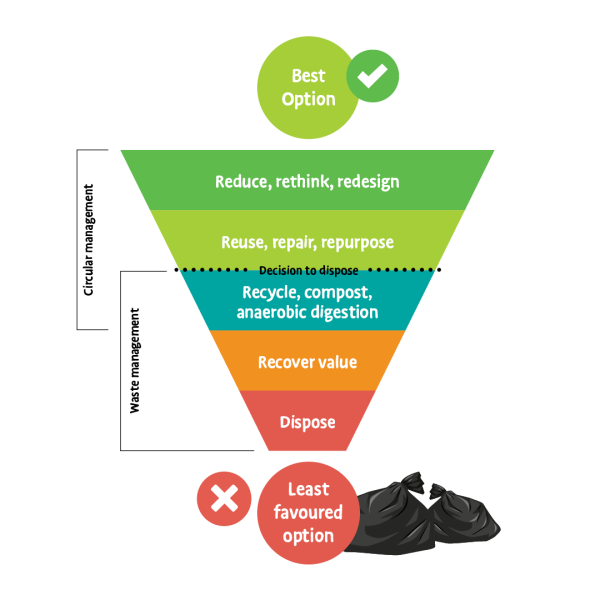
The waste hierarchy helps us to make sense of how we can approach waste minimisation and deal with it responsibly.  

Reduce/Rethink/Redesign

The easiest way to minimise waste is to avoid it in the first place. 

Reduce is at the top of the hierarchy, because if we do that first, there’ll be less waste left over to dispose of. 

These simple examples of waste reduction mean there is less (or nothing) to dispose of at the end.

Rethink is about thinking differently about tasks that you are doing, asking yourself is there a better way, which will avoid creating the waste in the first place?

Redesign is about designing out the waste.  When producers are creating a new product, they need to consider end-of-life and resources being used. 

Here are some easy, everyday examples:

  • Buy loose fruit and vegetables instead of packaged items.

  • Take your own container to a sushi shop instead of using their disposable container.

  • Ask staff to leave a straw out of your drink at a bar or café.

Reuse/Repair/Repurpose

The next-best way to minimise waste is to reuse. Reusing is all about seeing waste differently – not as something to be disposed of, but as something that can be used again, and again. This means they have a much longer lifespan before they end up being recycled, composted or disposed of in landfill. Here are some ways to reuse items that you may already be familiar with:

  • Take the same bags to the supermarket each time

  • Carry a reusable water bottle whenever you’re out and about – most cafes are happy to refill for you - just ask.

  • Use old scarves and handkerchiefs as ribbons or gift wrap.

By learning and keeping the skills of repairing alive we can keep items in use for much longer.  

Repurpose items into new useful things rather than throw them away.  There are often other ways that resources can be given further uses.  

Recycle/compost/anaerobic digestion

The third approach on the hierarchy is something we’re all familiar with – recycle. Recycling is when we convert waste into a new object or material. It’s another great way to keep things out of the landfill.

Recycling has been done for many years, because it uses less energy and raw materials than producing new items from scratch. It’s also typically cheaper to recycle than send items to landfill.

However, recycling can only be successful if everyone takes responsibility to recycle correctly.

Recycling is third on the hierarchy because it is still energy-intensive and not completely waste-free; if recycling is contaminated, then the items still end up going into landfill, and some things can only be recycled a certain number of times:

  • Plastics can only be recycled a few times, depending on the plastic. Paper and cardboard can typically be recycled four to six times.

  • Glass, steel and aluminum can be recycled infinitely.

So, while it is great to recycle, we should all be encouraged to look further up the hierarchy and focus on how we can reduce and reuse!

Composting food waste and garden waste returns these nutrients back to the earth.  There are many great composting systems available such as worm farms, compost bins and bokashi bins.  Hamilton also provides a kerbside collection service for food scraps. Hamilton City Council provides a kerbside collection service for food scraps which are turned into compost via a large-scale hot compost system. 

Anaerobic digestion is a process where bacteria break down organic waste in an engineered digester (without oxygen) into biogas and biofertiliser.

Recover value

Recover any remaining value, sustainably and without increasing emissions (e.g. chemical recycling, renewable energy).

One way you can recover value from a product that would otherwise go to landfill is through chemical recycling. For example, the life of synthetic textiles such as polyester or nylon can be extended by breaking down the fibres to their basic chemical components and reforming them into new fabric. This process is not widely available in New Zealand. Chemical recycling uses more energy than mechanical recycling but less energy than virgin plastic. In this instance, the best option would be to avoid this type of material in the first place.

Dispose

If you’re not able to reduce, reuse or recycle, your rubbish needs to be disposed of responsibly. Use your kerbside red bin at home and take any excess rubbish and recycling to the Lincoln St Resource Recovery Centre.  Dumping rubbish in a public space is illegal and will result in fines. 


 Council does not provide waste collection for businesses and community groups. This service will need to be sourced by a private contractor.


The reality of landfill

A landfill is a huge hole in the ground where our rubbish is dumped, heavily compacted and covered with soil. Because there is no oxygen in landfill, waste can’t break down properly. Organic waste (food, garden waste, paper and wood) is particularly problematic in landfill. Due to the anaerobic environment, the waste emits methane, a powerful climate change gas. The other toxic byproduct created in landfill is leachate – liquid that trickles through and mixes with the waste. It takes energy and resources to capture these byproducts and not all of it is able to be captured. Rubbish sometimes escapes from older landfills and contaminates our waterways. Many valuable resources are wasted in landfill. It makes ecological and economic sense for us to operate at the top of the waste hierarchy and reduce the amount of waste we send to landfill.

Take a look at Hamilton’s recycling

We hold fun and interactive education sessions at the EnviroNZ Education Room which overlooks the Materials Recovery Facility on Sunshine Avenue in Hamilton. This is where all the recycling from your yellow bin goes to be sorted. We often find that seeing for yourself is the best way to understand the importance of the waste hierarchy and change the perception of what waste is.

When you visit the education room, you’ll meet one of our educators, who will be your guide and waste minimisation guru. During the session you’ll be able to see the whole process – from when items arrive at the centre in the collection trucks and the sorting process, through to being baled for transport and recycling. 

As our sessions can be tailored, the Education Room is useful for all ages and stages of life. So whether you’re five or 105, we guarantee it will be fun and everyone will learn something. Tours are completely free and can cater for up to 30 people per visit.

We cater to:

  • students 

  • teachers wanting to use the room as a resource to support classroom work

  • community groups

  • businesses wanting to support and grow in-house sustainability initiatives

If you’re not able to visit the Education Room, there are plenty of other ways you can learn about the impact of your waste, and how to reduce your waste.

Education Room Bookings

Details
Your contact details

How would you like to be contacted about this request?

Feedback

Has this page been helpful?
Thanks for your feedback.