
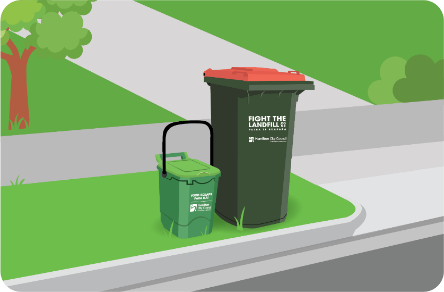
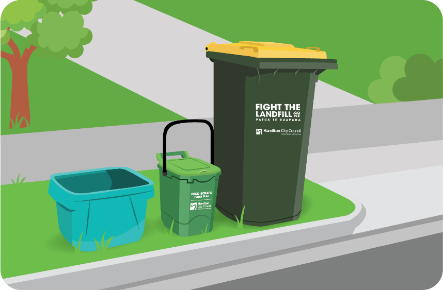
There are four bins that make up our kerbside collection.

  • Food scraps bins

    Weekly collection. For fruit, vegetables, cooked food, meat, fish, coffee grounds, etc.

  • Glass crate

    Fortnightly collection with yellow recycling bin and food scraps bin. Clean/rinsed glass bottles and jars. No lids

  • Red rubbish wheelie bin

    Fortnightly collection alternating with recycling. For items that cannot be reused, recycled or donated.

  • Yellow recycling wheelie bin

    Fortnightly collection alternating with rubbish. Clean/rinsed plastics 1, 2, 5, tins and cans with lids off, paper and cardboard.

What to do on bin day

Red week…

Rubbish wheelie bin and food scraps bin

Yellow week…


Recycling wheelie bin, food scraps bin, and glass crate

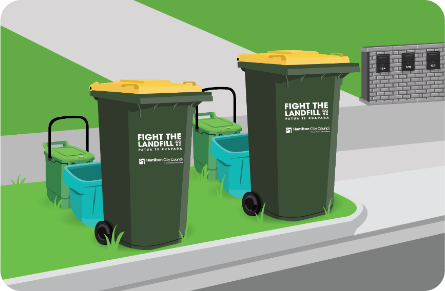
  • Have your bin out by 7am. If you’re not an early bird, put it out after 5pm the day before so you don’t miss collection. 

  • Place bins as close as possible to the kerb

  • Bins aren’t overfilled / lids are closed

  • Footpaths, cycleways, driveways and other accesses are clear

  • Fight the Landfill logo is facing the road

  • Leave space around the bins so the truck can pick it up – half a metre is great.

  • Make a note of your serial number (the number engraved in the side of the bin) so you are using the bin assigned to your property (not someone else’s!).

Where does it all end up?

The rubbish, recycling and food scraps collected on our kerbside is taken away to be composted, recycled or sent to landfill. 

  • Glass is recycled onshore.
  • Food scraps are taken to Hampton Downs and turned into compost. 
  • Rubbish is sent to landfill at Hampton Downs.

Plastics (#1, #2 and #5), paper, cardboard, aluminum, and steel are sorted and baled at the EnviroNZ Materials Recovery Facility in Sunshine Ave and then transported to other facilities for processing both here and overseas. You can book a visit to the Education Room to find out more.

FAQs

What can I put in the green bin?

Using the food scraps bin is a simple and effective way to minimise waste at home. It’s important we try to divert as much food and green waste as possible from landfill, where it turns into methane, a toxic greenhouse gas. The world’s food waste currently makes up 6.7% of all carbon emissions!

You can add the following items to your kerbside bin:

  • Fruit and vegetables (raw and cooked)
  • Bread, dairy and cooked food
  • Meat and fish bones
  • Egg shells
  • Seafood shells
  • Indoor cut flowers

Hamilton currently diverts between 340,000–400,000kg of food waste each month from the kerbside food scraps bins.

How can I reduce smells in the summer?

We know there can be some challenges to using the food scraps bin, especially in summer. Some ways you can keep the smells in and the bugs out include:

  • freezing animal products until rubbish day
  • set a phone alarm as a reminder to take it out of the freezer for collection – or download the Antenno app which sends reminders of kerbside collection days!
  • keeping the bin in a shady place or the garage
  • keeping the handle in the upright locked position
  • washing the bin at least once a month with warm, soapy water
  • lining the bin with brown paper or newspaper to keep it clean

What can I put in the glass crate?

Examples of what you can recycle

  • Glass bottles of any color

  • Food and beverage jars/bottles

Examples of what you can't recycle

  • Broken glass of any kind - please wrap and place in red bin.

  • Glass cookware or bakeware like a pie dish or measuring cup – if it’s still in usable condition, please donate it. Otherwise, please put it in the red bin

  • Window glass – please take this to Lincoln St Resource Recovery Centre for recycling.

What can I put in the yellow bin?

Examples of what you can recycle

  • Soft drink, juice, water, and milk bottles (usually made from plastics numbered 1).

  • Bathroom and laundry product bottles (usually made from plastics numbered 2).

  • Large yoghurt and ice cream tubs, margarine/butter tubs (usually made from plastics numbered 5).

  • Some pharmaceutical, cosmetics, sauce, and refillable bottles (usually made from plastics numbered 5).

  • Fruit punnets and meat trays (usually made from plastics numbered 1).

  • Clean drink cans and food tins.

  • Paper and cardboard including pizza boxes (food scraps removed).

Examples of what you can't recycle

  • Aerosols, pots, pans, and foil (and items you normally find in a garage or garden that contain chemicals).

  • Tissues and paper towels (these usually have food scraps or cleaning chemical residue).

  • Takeaway coffee cups, drink cartons, shiny gift wrap (these items can include other materials like plastic or metal).

  • Soft plastics (any plastics that can be scrunched into a ball) - check out the Soft Plastic Recycling Scheme for a store locator to recycle these plastics

  • Compostable packaging and containers

  • Nappies and sanitary products

  • Fabric and clothing


What’s the go with plastic lids?

Lids can fall through the conveyor belt during processing and cause damage to the sorting machines. Please do not put them in your yellow bin. People can dispose of them for free at the Lincoln Street Resource Recovery Centre, where they will be collected and manually added to the recycling sorting process. From there, they are sorted and sent to a repurposing plant and made into new products.

What can I put in the red bin?

Your red bin is your last resort – anything that can’t go in the yellow bin, food scraps bin or blue/green grate goes in the red bin (so long as it’s not a prohibited item).

Prohibited items include:

  • Medical waste (except Rapid Antigen Tests).

  • Chemicals and hazardous items.

  • Lithium batteries (includes vapes) 

  • Hot ashes or liquids  

We encourage you to use the mixed recycling wheelie bin, glass recycling crate, and food scraps bin which should limit the amount of rubbish going into your red bin, and therefore, to landfill. 

 If you have excess rubbish you can take this to the Lincoln Street Resource Recovery Centre.

Why can I only recycle plastics 1, 2 and 5?

As of 1 February 2024, the Ministry for the Environment requires all Councils across New Zealand to only collect plastics numbered 1, 2, and 5 in kerbside collections.

This is so no matter where you live in New Zealand, the same service is available everywhere. In Hamilton, plastics 1, 2 and 5 are collected in the yellow bin (along with paper, cardboard, clean drink cans and food tins). Glass is still collected separately in your green/blue crate.

To check the plastic number, check the number at the bottom of the item. If there's no number or you can't read it, put it in the rubbish bin.

Lids (unless physically attached) cannot be recycled and go in the rubbish bin - they're difficult to sort being small and light. Dirty containers need to be rinsed before they're recycled.

To find out more about the changes, click here.

Not sure what item goes in which bin?

Try this handy sorter below

What day do I put my bins out?

Enter your address here

Feedback

Has this page been helpful?
Thanks for your feedback.