
Making sense of Government’s new council profiles
Government, via the Department of Internal Affairs (DIA), has introduced ‘council profiles’ to compare key statistics between councils. The project’s stated aim is to boost transparency and accountability of local government.
Hamilton City Council supports initiatives which help the wider public understand the opportunities and challenges councils deal with. However, there is concern in the sector that comparing councils through these profiles may be misleading and confusing.
- Councils are so different, and have such differing services and challenges, that there is no meaningful way to compare financial information in a simple table.
- There are concerns among the sector, especially heading into local government elections, that the tables could be used in isolation to claim a council is performing better than another. Unfortunately, some people do take shortcuts, and may take the opportunity to use the information to make claims that lack context and lead to misinformation.
Councils concerned over confusing data presentation
The DIA is showing rates increases differently to how they have been traditionally reported and discussed. For many years, councils, community members and media have reported rates increases based on the average rate change for ratepayers. These new council profiles calculate the overall increase in rates income received from the previous year, including additional revenue anticipated from new properties as the city grows.
This means rates rise percentages in the council profiles will be different to the average rates rise announced by councils – particularly for fast growing cities like Hamilton. It does not change the rates set by Council or the annual rates for any property.
The DIA data also shows a percentage measure for Balanced Budget. This figure is designed to show whether a council is covering its operating costs through its everyday income. A figure of 100% or more means the council does not have to use debt to cover these costs.
Rates for growth councils (like Hamilton) are impacted by Government rules
Hamilton has been New Zealand’s fastest-growing city for the last two years and is expected to remain the fastest growing city for some time. As a Tier 1 high-growth metro, it must pay for Government’s requirements for growth.
Meeting Government’s requirements for Tier 1 growth councils means funding additional planning, legal and staff expenses as well as increased capital works and debt.
Rates comparisons don’t compare apples with apples
Hamilton has had historically low rates compared to other councils. Hamilton City Council had the lowest median residential rates of any major metro in New Zealand in 2023/24.
Our rates are still cheaper than many, but the argument shouldn’t be about who has the lowest rates. It needs to be who has sustainable funding to deliver the services its community wants and expects.
Besides the costs of growth, Hamilton’s operating and capital expenses have drivers very different to many councils. As a regional hub, we provide significant transport infrastructure to service regional public transport (including rail). As the largest business base in the region, we have a high proportion of our road users who are commuters who pay their rates in neighbouring districts. We operate and maintain a world-class zoo, an asset for our region which not every council is fortunate to have.
It's important to note Council’s projects (and therefore rates) reflect the community’s priorities through the Long-Term Plan and public consultation. Hamilton has invested in river paths, environmental initiatives, local theatres, Destination Playgrounds, sports fields and libraries because those things are important to our communities. Te Kete Aronui Rototuna Library is our newest hub library in the northern suburbs of Kirikiriroa and is a great example of a project designed with the community from the outset.
Debt (for the right things) helps today’s ratepayers
Hamilton’s debt levels have increased rapidly in recent years. But without this debt, today’s ratepayers would be substantially worse off.
In the three years to August 2024, Hamilton City Council and its partners completed $909 million worth of capital projects across the city. That is almost four times more what we receive each year in rates. Without debt funding these projects would have been impossible to pay for without significant rates increases.
Major infrastructure is a long-term investment. Like homeowners borrow many times their annual income to purchase a home, Councils use debt to plan and complete capital projects and smooth the cost over many years. It protects current ratepayers from huge hikes and means the people receiving the benefit of these facilities in the years to come also pay a contribution towards the cost.
Council staff numbers cannot be compared in isolation
No two councils are alike, and there are substantial differences in the services they deliver and how they deliver them. Staff numbers or costs (in isolation) do not consider services or assets provided, (other than Hamilton, very few councils operate a zoo!) and make no provision for councils which outsource operations.
Outsourcing could mean hundreds of roles are not visible on a simple comparison of staff numbers. Two councils may have similar staff numbers but one may contract out its mowing, graffiti removal or sports field maintenance while the other retains staff to deliver these services in-house.
Even a comparison of whether roles have increased or reduced at an individual council doesn’t provide useful information without context.
In recent years Hamilton has delivered a massively increased capital programme for major infrastructure as we opened new growth areas and met Government requirements. Hundreds of millions of dollars of new works means more staff to plan, manage, communicate and report on these projects.
A fast-growing city like Hamilton, with more kilometres of pipes, roads, and stormwater systems every year, means we need more staff just to maintain existing levels of service for repairs and maintenance.
Hamilton City Council continues to ensure staff levels are appropriate for the services our community wants and needs. In the past financial year, Council has already reduced headcount by 98 FTEs through a series of restructures and reduction of some workstreams.
Households pay around 15 times more to government than to councils
Council profiles are part of a push for greater transparency and reduced costs for householders. When you look at what an average household spends per year on tax and rates, around 93% goes to central government and only 7% to local government.
Infometrics estimates an average Kiwi household pays around $2,900 a year in rates – and $37,000 in tax. (Tax total is based on two median income earners and includes both income tax and GST.)
Council's key financial metrics
Under Council’s Financial Strategy, there are several key metrics against which we measure our financial performance.
Debt to revenue
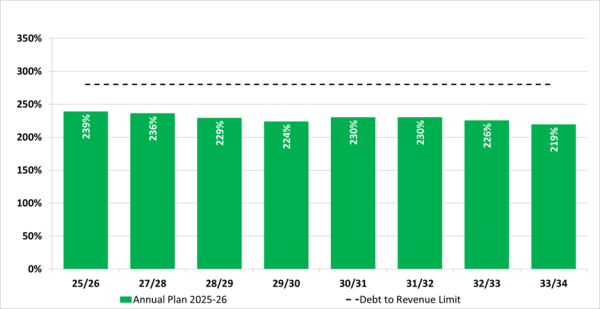
To keep debt to manageable levels, the Financial Strategy includes a cap on our net debt as a percentage of our revenue. In line with rules set by the Local Government Funding Agency (LGFA), Council’s lender of choice, this has been gradually reducing from 300% in recent years and is now set at 280%. This means we can borrow up to $2.80 for every $1 collected in revenue.
The LGFA has recently begun allowing for bespoke net debt-to-revenue ratios of up to 350% for high growth councils such as Hamilton City Council. Council has chosen to retain the 280% limit, with our net debt-to-revenue ratio projected to be well below that level each year, as shown below. The option to move to a bespoke limit remains available to Council should the need arise.
Water Supply and Wastewater have been excluded from 26/27 onwards
Net debt
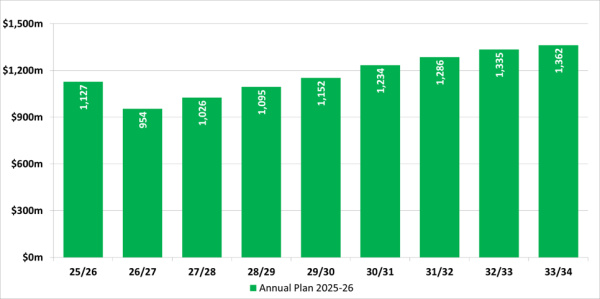
The graph below shows net debt (the total amount of external debt less cash and term deposits). Debt includes loans from banks and the LGFA as well as the interest-free loan from the government’s Housing Infrastructure Fund.
Water Supply and Wastewater have been excluded from 26/27 onwards
Balancing the books
This measure tracks progress towards our goal of paying for the everyday costs of running the city from everyday revenues (rates, fees, and user charges) rather than borrowing to make up the difference. We call this balancing the books. The graph below represents Council’s recent and projected balancing the books results.
This measure is different to – and more stringent than – the government’s ‘balanced budget’ measure that is referred to in the government’s data release. It applies a stricter definition of what counts as ‘everyday revenue’ to ensure that only revenue that is genuinely intended to be used to meet ‘everyday costs’ is taken into account. Unlike with the government’s measure, revenue that is intended to fund capital expenditure is not included in this measure.
As shown below, Council is due to balance the books every year from 2026/27. However, our ongoing stormwater asset revaluation may impact this. This issue is fully explained in the 2025/26 Annual Plan.

Water Supply and Wastewater have been excluded from 26/27 onwards
Rates
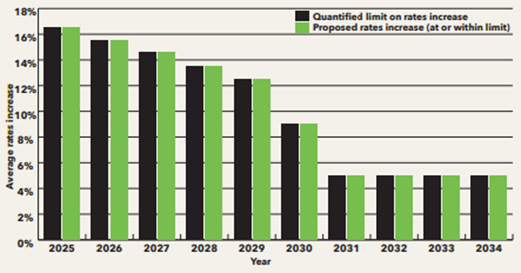
When we set a Long-Term Plan, we set a limit on rates increases to existing ratepayers over the 10 years covered in the Long-Term Plan. The projected rates increases to existing ratepayers over the course of the 2024-34 Long-Term Plan are set out below.
The total rates revenue we receive, which is what the government data release is focused on, will vary by a different amount, as that figure also takes into account rates revenue from properties that are newly rated each year. These properties increase Council’s overall rates collection. This is particularly relevant for Hamilton, which is the fastest growing city in the country.
For example, the below graph shows a 15.5% rates increase to existing ratepayers in 2025/26. Because of the additional rates from growth, the overall rates revenue increase in 2025/26 will be 16.9%, which is the number referenced in the government data release.
Further information
Feedback
Last updated 31 July 2025