Revising our Connections Policy – Managing growth in the interim
We’re currently reviewing our connections policy to make sure it’s as responsive as we need it to be to help us manage our networks. We’ll be talking to iwi, mana whenua and the development community more about this as the revised policy is drafted and there will be a full public consultation process.
Connections approvals are a legal mechanism under the Local Government Act (2002) and set out what requirements must be met for a new development to connect to our three waters networks.
Traditionally a granted resource consent would enable connection to the network, subject to certain standards and conditions being met, and development to proceed. Under our current policy there is an option for Council to decline a connection based on the impact on the network. This is not a tool that we have used before.
We don’t know the outcome of the connections policy review yet, but it is likely there will be a stricter criteria for new three waters connections in high-risk areas of the city until long-term infrastructure solutions are implemented.
Plan Change 12 – Changing the rules
As part of Council’s response to Government’s direction to provide more housing, and higher density housing, we’ve recognised we need to put additional mitigations in place to manage the effect on the city’s already constrained networks. These measures will help manage the impacts of higher density housing on our infrastructure and respond to our obligations to Te Ture Whaimana o Te Awa o Waikato. Plan Change 12 introduces provisions protecting our trees and gully networks, clear rules around permeable surfaces, on-lot stormwater management, rainwater re-use tanks and other measures to reduce the impact of development on the network.
The plan change also identifies the areas in the city where Council is prioritising higher density development. Rather than allow intensification anywhere, Council is focusing intensification in the central city and its immediately surrounding areas by setting the rules so it's easier to develop here than in the rest of Hamilton. Alongside these provisions, Council will be prioritising its infrastructure spend in these areas, so that additional capacity is made available to match the level of residential intensification. These measures will sit side-by-side with the revised connections policy.
Learn more about Plan Change 12
Infrastructure investment programme – The long-term solution
We continue to invest in our three waters networks. We can’t upgrade everything all at once, so we’re prioritising our investment to address existing system capacity constraints and meet future growth demands in our priority areas. This will mean that investment in other areas of the city will not be prioritised or publicly funded. Infrastructure capacity constraints may limit growth in those areas.
Investment is a long-term solution. As we invest, pressure will be eased in high-risk areas – but often there are a suite of investment that is needed to address capacity and performance challenges which takes time to implement. For example, over the last five years we have invested in new and upgraded wastewater interceptors, trunk mains, pumpstations and flow diversion which have improved our system performance and eased network pressure across the city including in the west, east and the central city.
We want to provide developers with as much certainty as possible and help deliver new housing for the city while also protecting the Waikato River. We have a programme of work in the central city - supported by the Government’s Infrastructure Acceleration Fund (IAF) – to invest millions of dollars in water and wastewater infrastructure. Over the coming years, more than $200 million will be invested into our central city’s water systems which will support growth and help unlock new housing. This investment includes funding for a new 25ML water reservoir and a pump station as well as wastewater upsizing and improvements.
Council has recently revised its Hamilton Urban Growth Strategy, which outlines priority areas in the central city and surrounds, along transport corridors and in greenfield areas. This will help us prioritise our infrastructure investment programme. We have an Infrastructure Strategy which sets out a 30-year investment programme to inform decision making. Currently, how, and when that investment is prioritised is decided by Elected Members, in consultation with the community, through the Long-Term Plan process.
Future investment programmes will prioritise the strategic infrastructure needed to service the central city. Developers will be expected to contribute toward or fund trunk and local infrastructure needs.
Planned investment in Hamilton's wastewater network
Click on the map to open it as a PDF.
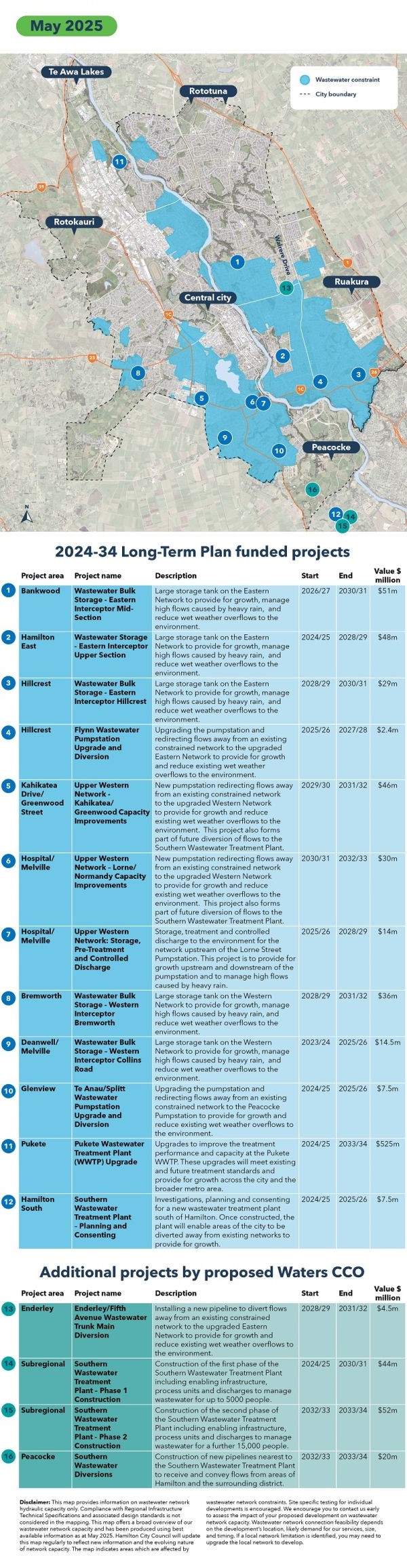
Wastewater network constraints in Hamilton after 2024-34 Long-Term Plan investments and proposed Waters CCO's investments
Click on the map to open it as a PDF.